SICK: A Memoir

Part I

Late-summer rainstorm in Denmark. Nearly black...

It’s the same dream.  Not the only dream I have, but the only one I remember.

Dad’s driving down the interstate, the sky so dark you might mistake it for dusk.  A rain drop pelts the windshield.  And then another.  Then a few more.  Not long after, the torrent comes, an army of fat droplets assaulting the windshield.  The wipers slosh waves of rain back and forth, not fast enough at even their highest speed to clear one sheet of rain before the next covers it, distorting the view.   This is how the dream always begins, and it’s always at this point in the dream that an eerie sense of calm comes over me. I realize I’ve dreamed this before, but believe with every ounce of my being that this time it’s real.

The rain halts. The sky lightens slightly.  A cone-shaped cloud forms in the distance. It’s a tornado.   I blink, thinking how much this is like the dreams I have.  I’ve always wanted to see a tornado, I think.  They look so much like cotton candy spinning in the machines at the fair, so soft and innocent looking.  You want to touch it as it forms though you know you shouldn’t.   The cloud lowers, growing bigger and darker until it barrels into the ground and stirs up the earth.  On the other side of the highway, another cloud rotates, spiraling into a tight spin, stretching until its end reaches the ground.  The larger twister splits into two that dance around each other before heading in separate directions.

I look to Dad who is more mannequin than man.  His arms rock back and forth slightly, keeping the steering wheel in position.  His gaze remains forward, unwavering.  I don’t say a word.  We ride into the storms, mesmerized, until the very last moment of the dream when the clouds aren’t so pretty and soft, but angry and moaning.  The darkness surrounds us, and I realize this is a dream and my real nightmare is about to begin.  The desperate gasping wakes me.  It always wakes me first.

Part II

“Sadie’s choking!!!  She’s choking!!”  I scream as I race toward my parents’ bedroom. My older sister stands in the middle of the hall, grasping her neck, her mouth agape, her pretty brown eyes wide with terror.  “She’s choking.  She’s choking!”

Dad bolts past me before I even enter his bedroom.  Mom’s at his heels.  I race into their bedroom, pick up the phone, dialing 9-1-1.  I don’t know why the dispatchers don’t greet me by name.  Someone in my house chokes every other night, except for me.  It’s never me.

“Hello, 9-1-1.  What’s your emergency?”

“My sister’s choking! We need an ambulance!”

“Is there an adult there with you?”

“Are you sending an ambulance!?  We live at 88 Stratton Circle. You have to send them now!  She’s choking!”  I hear her fingernails tapping the buttons on a keyboard , hopefully typing in our address  and summoning the ambulance now.  I’ve done this too many times.  Best to get the ambulance en route and allow the dispatcher to ask her twenty questions afterward.

“Is there an adult there with you?”

“Yes!  They’re helping her.  Hurry!  You have to hurry!”

“What is she choking on?”

“Nothing.”

“You mean you don’t know what she’s choking on?”  The dispatcher asks, her voice laced with confusion.

“No.  She’s choking on nothing.  They do this every night!”

“Oh.”  She says, recognition heavy in her voice.

“An ambulance is on the way, Andrea, but I need you to stay on the phone with me.”

Thirty seconds, I think to myself.  It’s been thirty seconds, and the ambulance is probably just getting on the road.   She has a minute and a half before she passes out.  Four and a half minutes before she’s dead.  But they never pass out, I tell myself.  They never pass out.  She’s not going to die.  She’s not going to die.

“Hello?”

“I’m still here,” I say.  I look through my parents door to see my father slapping  Sadie’s back in a desperate effort to help her catch her breath.  His eyes, Mom’s eyes, and surely my eyes, reflect the same terror in Sadie’s.  She gives another horrific gasp.  I cover my ears and close my eyes tight as though that will somehow make it all go away.   Prayers race through my head.  God don’t take my sister.  Help Sadie.  Save her.  Make it stop.  And then, the squealing gasps soften, elongating into deep breaths, and I know it’s over.  At least for now, it’s over.

“She stopped.”  I tell the dispatcher.  “She’s not choking anymore.”

“Do you want me to still send the ambulance?”

“Mom, do you want them to still send the ambulance?”  I call, but I already know the answer.

“No,” she says.

Help Fund The Second Novel in The Fairytale Keeper Series and Get a Reward!

Andrea Cefalo with StudentWhether finishing a masterpiece or just getting started, the most daunting task for authors is coming up with the funds. In the not-so-distant past, writers relied on major publishers to fund the editing and marketing of their novels. But times have changed. With the help of crowdfunding, authors are ditching publishers and going out on their own.  Self-publishing is nothing new, but with the use of crowdfunding, authors can get the money to create novels that rival traditionally published books.

When author Andrea Cefalo published her first novel, The Fairytale Keeper, she was told that indie authors need at least $5,000 to help fund their projects. Sadly, that was a gross underestimate. Cefalo says she’s spent far more than that, even though she does much of the work herself. “If I can learn how to do it, I do,” Cefalo said. “I spend my money where I think it makes the biggest impact–editing, marketing and advertising.” In order to fund the editing and printing of her second novel, The Fairest of All, Cefalo is turning to the crowdfunding website Kickstarter.

Cefalo’s second novel is the much-anticipated sequel to The Fairytale Keeper and is book two in The Fairytale Keeper series. The novel combines Grimm’s Fairy Tale characters, key players from the world of 13th century Holy Roman Empire and dynamic characters with real historical settings and events to create a tale that leaves the reader wondering where fact ends and fiction begins.

Since its publication, The Fairytale Keeper has become a quarter-finalist in Amazon’s 2013 Breakthrough Novel Contest, won Indie Book of the Day and was second runner-up in Writing.com’s Hook Us Contest.  As a result of these awards, Cefalo has gained positive reviews from Publisher’s Weekly, which says The Fairytale Keeper is “a…resonant tale set late in the 13th century… with unexpected plot twists. An engaging story of revenge and redemption… An opener to a future series.” A professional reviewer from Amazon’s contest says it is a “really great story. The author’s style reminds me of many great historical fiction pieces that I’ve read. Strong emotion injected into almost every page.”

So if you want to help an up-and-coming author see her dream of publishing her second novel become a reality, please visit her Kickstarter page, share it with your friends, and consider supporting her with a donation.  All donations come with a reward of equal or greater value than the donation itself!

The Influences on 13th Century Renaissance Man, Frederick II

Frederick II’s Intellectual Roots

Similar to his grandfather, King Roger II of Sicily, Frederick was interested in intellectual pursuits and legislative matters.  Roger consulted travelers and commissioned them to help him create a better world map, only recording what was agreed upon.  His pursuits resulted in a great silver map in the year 1154. The emperors following Roger, William I and William II, didn’t share Roger’s vigor for scientific pursuits, but like Frederick, did study and have Greek texts translated.

Frederick II Looks Back to Greek and Egyptian Thinkers

Bust of Aristotle. Marble, Roman copy after a ...

Bust of Aristotle by Lysippos from 330 BC

Frederick made a conscientious effort to surround himself with the best and brightest minds of his time, reaching out to anyone who could answer his questions: Moslems, Jews, and Christians alike.  One such man, referred to as Michael Scot, born in Scotland (hence the surname) but educated in Spain, composed works on astrology, meteorology, astronomy, and pysiognomy and dedicated them to Frederick.   These works illustrate Scot’s familiarity with the works of Ptolemy.

Frederick himself was a known admirer of Aristotle.  Though Frederick didn’t always agree with Aristotle, he certainly shared his interests and methods.  Like Aristotle, Frederick studied physics, poetry, logic, linguistics, government, biology, and zoology. Also like Aristotle, Frederick often studied the scientific world through detailed observation, especially in the areas of zoology and biology. He collected animals from across the known world, including panthers, a giraffe, elephants, camels, and a menagerie of birds.  In his studies, Frederick went beyond Aristotle’s scientific method, conducting experiments, though not like what we know today as the scientific method.  Frederick certainly made hypotheses and predictions.  He also tried to set up controls.  However, many of his experiments couldn’t be replicated because they were highly unethical and often resulted in the death of the subject matter.

Frederick II Looks East to Moslem Leaders

Al-Kamil (right) and Frederick II signed a tre...

Al-Kamil (right) and Frederick II signing a treaty restoring Jerusalem to the Crusaders for ten years.

As said earlier, Frederick reached out across the known world for answers to his many questions.  In scientific matters, he often reached out toward Arab leaders. It was rumored that Frederick preferred the company of Moslems, especially when it came to learning.  While this cannot be confirmed, we do know that Frederick often looked eastward when trying to quench his thirst for knowledge.

Frederick was well-known for his acceptance of other beliefs and cultures.  So it’s of no surprise that he  was reluctant to go on crusade against the Islamic east, but after much pressure Frederick did go.  He brought a Sicilian Moslem to tutor him in logic while on crusade. Unlike most crusades, Frederick’s led to a positive relationship with Moslem leaders both commercially and politically. By 1236, the sultan of Egypt sent the emperor a scholar named Theodore, who was, for his time, an expert in math, astrology, and medicine. This however, did not quench Frederick’s thirst for knowledge.  Much like his grandfather Roger, Frederick wasn’t satisfied with a theory unless it was widely agreed upon.  Frederick composed questionnaires, in which he puzzled through scientific, mathematical, and theological mysteries.   Frederick sent his questionnaires to Moslem leaders in the hopes that they could tap their intellectual resources and find answers.

While on another trip to the east, Frederick asked if he could interview an expert on astronomy.  Rather than allow the interview, the sultan Malik al-Kamil sent Frederick an astronomer/mathematician by the name of al-Hanafi.  The sultan of Damascus, al-Ashraf, who was also aware of Frederick’s interest in astronomy, sent him a planetarium with figures of the sun and moon which marked the hours as they made their rounds, a gift valued at 20,000 marks.

Related Articles:

Sources:

“Frederick II (Holy Roman Emperor and German King).” Www.encyclopia.com. N.p., 2013. Web.

Haskins, Charles H. “Science at the Court of the Emperor Frederick II.” The American Historical Review 27.4 (1922): 669. Print.

Can’t wait to get your hands on a copy of The Fairytale Keeper? Order it now @

smashwords1Amazon LogoBarnes and Noble Logo

Are you a fan of all things Medieval?  Love Grimm’s Fairy Tales?  For the latest and greatest on these topics and for up-to-date information on The Fairytale Keeper series Subscribe to our newsletter  or follow me @

facebook buttongoodreads-blacktwitter-red-webtreatsetcpinterest-logo1-300x300

Frederick II: 13th Century Renaissance Man

Frederick II, Holy Roman Emperor

English: Frederick II, Holy Roman Emperor (Photo credit: Wikipedia)

Frederick II was a man of insatiable curiosity in a variety of subjects, including, but not limited to: physics, poetry, logic, linguistics, government, biology, mathematics, and zoology.  The plethora of intriguing facts about Frederick’s exploits in order to gain a better understanding of the world around him and that beyond him has lead me to break up one article on the Holy Roman Emperor into a half-dozen.  So hold onto your hats, Medieval enthusiasts, as we explore a fortnight’s worth of articles on Emperor Frederick II.

Frederick ruled the Holy Roman Empire on and off from 1220 to 1250.  As many of you know, my Medieval series,  The Fairytale Keeper, takes place during Frederick’s reign. Frederick is featured in the second novel in the series, The Fairest of All, which is what inspired me to do greater research on this remarkable man who one might argue could have inspired an early Renaissance if it weren’t for his constant battles with the Church.

Related Articles:

13th Century Kingmaker:  Konrad von Hochstaden


Can’t wait to get your hands on a copy of The Fairytale Keeper? Order it now @

Barnes and Noble LogoAmazon Logosmashwords1


Are you a fan of all things Medieval?  Love Grimm’s Fairy Tales?  For the latest and greatest on these topics and for up-to-date information on The Fairytale Keeper series Subscribe to our newsletter  or follow me @

pinterest-logo1-300x300facebook buttontwitter-red-webtreatsetcgoodreads-black

The Fairytale Keeper Book Trailer!

I’m very proud to (finally) present The Official Fairytale Keeper Book Trailer.

http://www.youtube.com/watch?v=oDvzLBk2M68&feature=youtu.be

I owe a great deal of gratitude to my very talented husband, Ken Morrill, who created this book trailer for me.

Can’t wait to get your hands on a copy of The Fairytale Keeper? Order it now @

Barnes and Noble LogoAmazon Logosmashwords1


Are you a fan of all things Medieval?  Love Grimm’s Fairy Tales?  For the latest and greatest on these topics and for up-to-date information on The Fairytale Keeper series Subscribe to our newsletter  or follow me @

facebook buttontwitter-red-webtreatsetcgoodreads-blackpinterest-logo1-300x300

Few men are memorialized in such a contradictory manner as Konrad von Hochstaden. Surely a man who laid the cornerstone of one of Europe’s greatest churches—The Cologne Cathedral—should be remembered fondly. And he is…sometimes. (See the mosaic below.) But Hochstaden gave the people of Cologne and the Holy Roman Emperor of the time several reasons to hate him. Perhaps that’s why a vulgar statue of Hochstaden sits on the side of Cologne’s City Hall. (Scroll to the bottom to see it. Warning: it’s rather vulgar.)
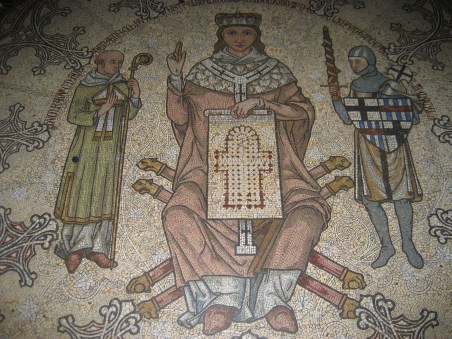
Mosaic Konrad von Hochstaden Cologne Cathedral

This mosaic from Cologne’s Cathedral shows a saint-like Konrad von Hochstaden holding the plans for the church’s construction.

The Complexity of Rule in Thirteenth-Century Europe

To better understand Konrad von Hochstaden’s power and influence, a very brief examination of Medieval Europe’s political structure is in order. At the time, Europe was a hodgepodge of kingdoms, principalities, duchies (areas ruled by dukes), counties (areas ruled by  counts), ecclesiastical sees (areas owned by the church), and free imperial cities.  Trying to decipher the boundaries between these areas when looking at the map below is a tad tricky.
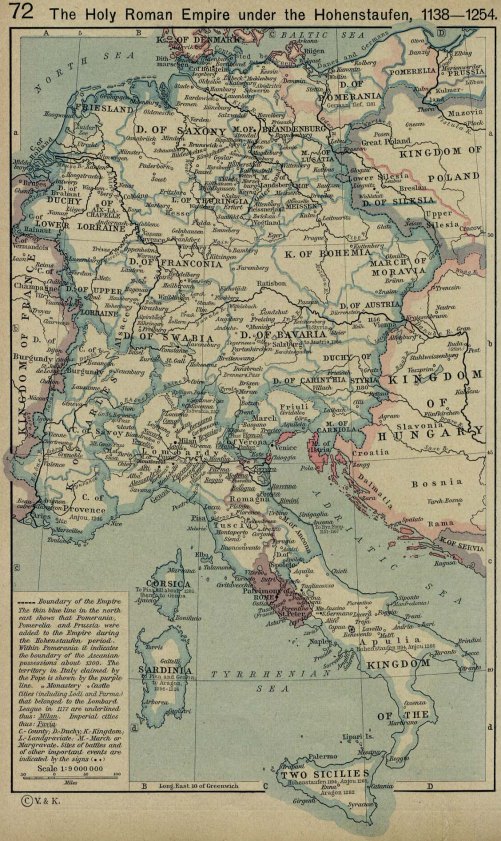
Thirteenth-Century map of Europe

This map of Europe shows the political boundaries under Hohenstaufen rule.

Beginning in the tenth century, the king of the Holy Roman Empire was called King of the Romans and, later, King of the Germans. These were the titles used during Hochstaden’s lifetime. In a nutshell, prince electorates selected a nobleman to fill the position of king. Typically when a Holy Roman Emperor died, the pope promoted the King of Romans to take the emperor’s place, which essentially made the newly crowned Holy Roman Emperor the official ruler of Central Europe. Although, the amount of power each emperor actually wielded varied throughout medieval history and depended on several factors.

While inheritance often played a role in electing the King of the Romans and the Holy Roman Emperor, these were not strictly inherited positions.  As I mentioned above, by the thirteenth century seven prince electorates—made up of four secular nobles and three church officials—ultimately decided who took the title of King of the Romans. The archbishop of Cologne was one of these prince electorates.  One might argue that these kingmakers were even more powerful than the king himself.  We certainly see this when examining the life of Konrad von Hochstaden, who was archbishop of Cologne from 1238 to 1261.
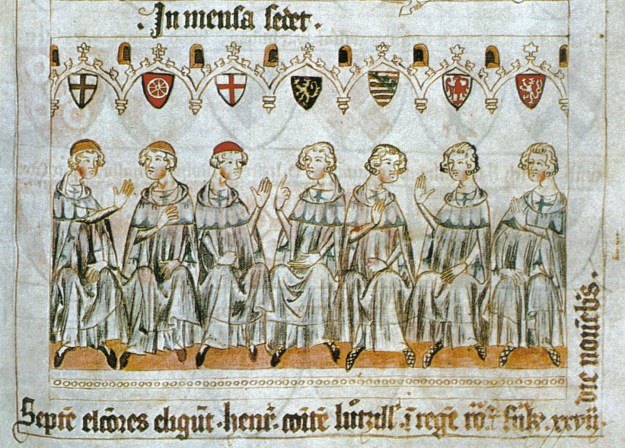
Prince Electorates Holy Roman Empire

This miniature from the Chronicle of Henry VII (1341) shows the seven prince electorates. The archbishop of Cologne sits below the shield with the black cross.

Konrad Von Hochstaden’s Rise to Prince

Konrad von Hochstaden came from noble blood, his father being Count Lothar of Hochstadt.  We know little of his childhood, but by 1216 he was the beneficiary of the parish of Wevelinghoven, and in 1226, he was promoted to canon.  He eventually ended up in Cologne as the provost of the cathedral. When Archbishop Henry of Molenark died in March of 1238, the chapter named Konrad as his replacement, an appointment that Holy Roman Emperor Frederick II approved in August.Surprisingly, Hochstaden wasn’t even a priest at the time. That was a title he’d earned the following year.
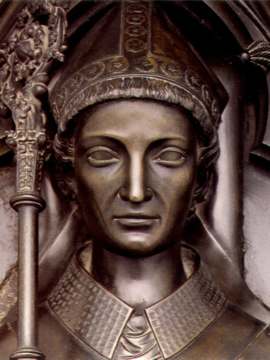
Konrad Von Hochstaden

Konrad Von Hochstaden was laid to rest in the Johannes Chapel of the Cologne Cathedral.

Konrad von Hochstaden Turns Against Frederick II

For the first year of his term as archbishop, Konrad supported the emperor in his disagreements with the pope, but when Pope Gregory IX issued Emperor Frederick’s (second) excommunication after he invaded a papal fief, Konrad’s loyalties shifted and he sided against the emperor with the pope and Archbishop of Mainz.  It was a decision Hochstaden must have regretted in 1242 when he was badly wounded in battle against the emperor and captured by the Count of Julich, though he was eventually freed. By 1245, Konrad’s star was on the rise again.
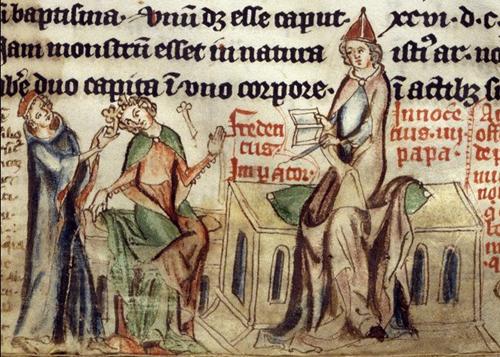
excommunication of emperor frederick ii

This fourteenth-century illumination portrays Pope Innocent IV excommunicating Emperor Frederick II.

Trouble in Cologne

By supporting the pope, Konrad von Hochstaden’s power grew.  He now had two duchies and the ecclesiastical see of Cologne, making him the most powerful man in Northwest Germany.  Not everyone was pleased with Konrad’s quick rise, and this resulted in struggles for power with his noble neighbors (Remeber the Count of Julich?) and the people of Cologne, who often refused to accept his authority.  His ruthless methods in dealing with the people of Cologne left him with a malicious reputation.

English: Albertus Magnus (fresco, 1352, Trevis...

Albertus Magnus (fresco, 1352, Treviso, Italy)

Hostilities grew, so a theologian and scholar by the name of Albertus Magnus was brought in to help bring the people of Cologne and the archbishop to peace.  This event is referred to as the Great Arbitration.  Konrad lost some power in the bargain.  After which, he tried unsuccessfully to pit the craftsman against the patricians in order to gain favor.  He died two years later, and when his successor, Engelbert II, tried to fortify one of the city’s towers, he was arrested and imprisoned by the Count of Julich for little over a year for violating the terms of the Great Arbitration.  Meanwhile, Cologne gave way to violent battles between the wealthy families of Cologne.  Unfortunately for Engelbert, he supported the losing side, and rather than continue his fight for Cologne, he abandoned it for his palaces in Bruhl and Bonn.

A league of German nobles defeated Engelbert’s successor, Siegfried of Westerburg, at the Battle of Worringen in 1288.  After this, the archbishops of Cologne would no longer reside within the city walls.  But Cologne would not officially have its freedom from the Church until 1475 when it was declared a Free Imperial City.

Battles for the Crown

Let’s go back to the battles between the Church and the emperor. In 1242, Frederick II selected Henry Raspe, Landgrave of Thuringia, and King Wencelaus of Bohemia  as protectors of Germany until his young son Conrad was ready for the task.

A papal ban against Emperor Frederick was issued three years later.  Raspe betrayed the emperor, siding with the pope, and was elected king in opposition to the boy he had earlier sworn to protect, Conrad.  Henry experienced success on the battlefield, beating Conrad in the Battle of Nidda.  Unfortunately for Henry, his reign was short.  He died of illness only seventeen months after being named king.
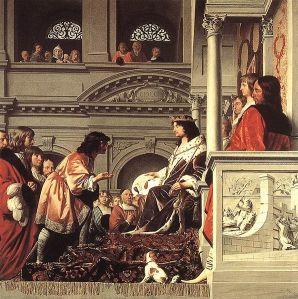
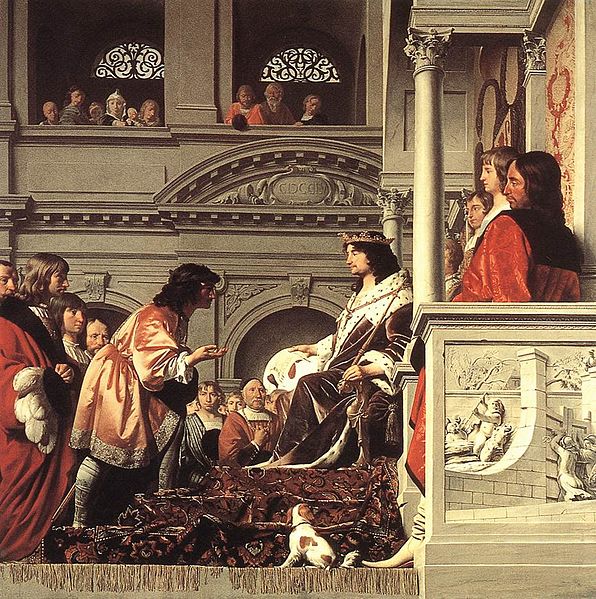
King William II of Holland Granting Privileges by Everdingen and Post 1654

King William II of Holland Granting Privileges (Caeser Van Everdingen & Pieter Post, 1654)

Supposedly many noblemen were considered to fill Raspe’s shoes, but the anti-king crown fell to the young Count William of Holland.  In April of 1248, Holland sieged Aachen, the place where German kings were traditionally crowned.  It took six months for Aachen to fall, but when it did, it was the Archbishop of Cologne, not the Pope, who placed the crown on William’s head.

Konrad von Hochstaden’s faithful service to Pope Innocent was reward with the position of Apostolic legate in Germany, but Hochstaden reached higher.  He secretly encouraged the people of Mainz to ask the pope to make him their new archbishop.  This would make Konrad a double-prince elector since the Archbishop of Mainz also gets to vote on who becomes king.  The pope gently denied Konrad the position, which caused Konrad to turn against the pope.  The apostolic legation was taken from Konrad.  Konrad turned from King William of Holland, as well and used every means necessary to dethrone him.  He probably would have succeeded if William hadn’t died first.

After the death of King William, it was time for Konrad to find another king.  His vote fell to Richard of Cornwall, brother to King Henry III of England.  In trade for his support, Konrad was gifted full imperial authority over his principalities and the right to name bishops in Richard’s stead.  Konrad von Hochstaden died four years later.  Ironically, his remains lie in the Cathedral of the city where he was most hated: Cologne.

I hope you enjoyed this article on Konrad von Hochstaden.  Hochstaden plays a key role in my medieval fiction series, The Fairytale Keeper.  This article is a part of a series on real historical figures from the time period who appear in The Fairytale Keeper series.  As promised, here is that vile statue of Konrad von Hochstaden.



profile picAndrea Cefalo is a Medieval fiction author and history blogger. Her debut novel The Fairytale Keeper, was a quarter-finalist in Amazon’s 2013 Breakthrough Novel Contest. The sequel–The Countess’s Captive—was published earlier this year.  She is currently working on the third book in her series.

Did you enjoy this article? Well, there’s more where that came from! Check out the archives or peruse the sidebar for a list of trending posts.  To make sure you don’t miss out on my latest articles, follow this blog or sign up for the newsletter.

And if you happen to be a historical fiction reader who loves a strong female voice and gritty Medieval settings, check out The Fairytale Keeper series. (When a storyteller’s daughter attempts to avenge her mother, she gets caught in the cross-hairs of a power struggle between kings and kingmakers. The conflict gives rise to some of the greatest stories ever told: Grimm’s Fairy Tales.) Publisher’s Weekly calls The Fairytale Keeper a “resonant tale set late in the 13th century…with unexpected plot twists. An engaging story of revenge.”

Further Reading and Sources:


The Real People in The Fairytale Keeper

medieval king

He reminds me of Conrad IV.

I love the Middle Ages, but, to be honest, most of my research time goes into my book.  I am learning more and more every day about the power players during the middle thirteenth century in the Holy Roman Empire.  I don’t recall learning much about the Holy Roman Empire when I was in school.  Most of the Medieval studies focused on England, France, Spain, and Italy.  All those kingdoms, duchies, counties, and ecclesiastical sees in central Europe just aren’t given much time.  As a former teacher, I understand that,  you can’t cover everything, and, in a way, I appreciate it.  Not having learned much about this area made me want to learn more, so I explore it every day.

I was thinking about all I’ve learned about the REAL people who I write in The Fairytale Keeper series, and I thought it would be fun for my readers to learn a little more of these fascinating people who are unknown to most of us.  I hope you enjoy what’s coming up, and that it makes you curious as to how it will all end up in The Fairytale Keeper series.

So now you know what my favorite time period in history is, what’s yours??


Can’t wait to get your hands on a copy of The Fairytale Keeper? Order it now @

smashwords logoAmazon LogoBarnes and Noble Logo


Are you a fan of all things Medieval?  Love Grimm’s Fairy Tales?  For the latest and greatest on these topics and for up-to-date information on The Fairytale Keeper series Subscribe to our newsletter  or follow me @

facebook buttonRed Twitter Buttongoodreads-blackPinterest Logo

Elizabeth Woodville: The Red Rose Turned White

A Red Rose by Birth

Elizabeth Woodville (1437–92), Queen Con...

Elizabeth Woodville (1437–92), Queen Consort of Edward IV of England (Photo credit: Wikipedia)

To understand Elizabeth’s allegiances, we must first examine her mother, Jacquetta of Luxembourg.  At the age of seventeen, Jacquetta was married to the Duke of Bedford, uncle to King Henry VI of England.  The marriage was political.  Since Jacquetta was related to the Holy Roman Emperor, it was assumed that this marriage would bind England and the Empire.  Two years later, the Duke of Bedford died.  The Duke’s chamberlain, Richard Woodville, was ordered to bring Jacquetta to Henry’s court.  Richard and Jacquetta fell in love and married in secret.  Elizabeth was born within a year or two of the marriage. Needless to say, the hasty marriage was scandalous and resulted in a large fine, but once the fine was paid King Henry forgave the pair.  About eight years later, the king married another of Jacquetta’s relations (by marriage), Margaret of Anjou.  This made Jacquetta a relation to both the  king and the queen, putting her family in a powerful position.  Therefore, all the Woodville’s, including Elizabeth, were supporters of the Lancasters.  But Elizabeth’s love affair and hasty marriage would change their allegiances forever.

Upon entering Margaret of Anjou’s court, Elizabeth Woodville quickly became known as the belle of England.  She was a fair-faced, heavy-lidded, flaxen-haired beauty.   Letters between Richard Neville and Richard of York describe her as the loveliest and most sweet-mannered maid in court.  The two men tried unsuccessfully to marry her to a poor knight, but Elizabeth used her fair face to rise.  She married the wealthy, yet handsome John Grey.

When King Henry went mad, leaving only an infant son for heir, the York cause grew stronger.  Clashes between Richard of York and Henry’s wife, Margaret of Anjou, fueled flames between the two lines.  Battles raged again, and most in England chose either the white rose of York or the red rose of Lancaster.  The Woodville’s remained loyal to the Lancasters.  Elizabeth and her mother, Jacquetta  served Margaret of Anjou faithfully.  Elizabeth’s father and brothers fought bravely against the Yorks.  Elizabeth’s husband, John Grey, lost his life under the red rose, dying in the Second Battle of St. Albans.

With the help of his cousin, Richard Neville, Earl of Warwick, Edward took the throne.  An alliance with France had been made. A marriage between King Edward and a French princess was being negotiated to secure the peace.  That marriage never happened.

A White Rose By Marriage

Edward IV meets his wife-to-be, Elizabeth Grey.

Edward IV meets his wife-to-be, Elizabeth Grey. (Photo credit: Wikipedia)

Elizabeth’s sons were denied their inheritance, and when Elizabeth heard the king was hunting near her mother’s castle in Grafton, Elizabeth, with a son in each arm, waited under a tree for Edward to ride by.  She dropped to her knees and begged for his mercy.  The young king fell for her immediately, but Elizabeth would not give herself lightly.  Edward was a known womanizer and Elizabeth denied him.  This only made Edward want her more. The two wed in secret in her family’s home on May 1, 1464.

Edward seemed reluctant to acknowledge Elizabeth as his wife.  She gave birth to their first child only five months after Edward publicly acknowledged her, and it took over a year for her to be crowned.

The irony of Edward’s choosing a Lancastrian widow was not lost and never forgotten by those who helped him to the throne.  Edward must have been quite besotted with her, knowing the marriage would not only upset the truce with France, but also his English allies.  Perhaps no one was more disappointed by this union than Richard Neville, who worked diligently to secure the alliance with France.

Evidence shows that Neville tried to get along with the Woodville’s at first even though it must have been frustrating to see Edward give up a strong French alliance so he could marry a commoner.  Adding injury to insult, Elizabeth hastily married her brood of siblings into the wealthiest and most influential English families.  Edward certainly treated Neville well, too, rewarding his loyalties with land and titles, but it never was quite enough for Neville.

Eventually, Neville rebelled the Woodville influence over the king, taking up his sword. He aligned with Edward’s younger brother, George, Duke of Clarence, waging war against the king several times.   At one point, Neville even sided with his former enemy, Margaret of Anjou, marrying his daughter to her son.  Neville had Edward on the run more than once forcing Elizabeth to spend time hiding with her children in sanctuary.

All in all, Elizabeth and Edward’s marriage was a fruitful one, producing ten children.  Elizabeth rose quite high, from a low-ranking noble to the Queen of England.

Richard III usurped his young nephew’s throne, holding him prisoner while claiming to plan a coronation for the boy.  Elizabeth’s son and brother, who served as guardians for the prince were executed.   Elizabeth took sanctuary with her children.  Richard demanded her other son be brought to court.  Whether Elizabeth sent him or a decoy is not known.  No one knows for sure what happened to the two princes, but two bodies were found in the Tower of London in 1674.

Elizabeth’s marriage to Edward was deemed illegitimate during Richard III’s reign.    Elizabeth and Margaret Beaufort arranged a marriage contract between their children: Elizabeth of York and Henry Tudor.  Upon the death of Richard III, Elizabeth was restored to the position of a dowager queen.   The marriage between Elizabeth and Henry united the Yorks and Lancaster under the white and red Tudor rose and ended the thirty year War of the Roses.

Article written by Andrea Cefalo, author of The Fairytale Keeper: a novel of corruption, devotion, and the origins of Grimm’s fairy tales.  To follow Andrea Cefalo and hear more about The Fairytale Keeper series, please visit:

Cecilly Nevile: Rose of Raby

Duchess Cecilly Neville

Article by http://www.bower2tower.co.uk/

cecily neville, duchess of yorkCicely Neville lived through the reigns of five sovereigns, six queens, and saw four Princes of Wales not succeed to the throne. Two of her sons became king only to die untimely. Her husband was killed in battle and his head struck off to adorn the walls of York. In an age of violence, conspiracy and short life expectancy, all but one of her twelve children survived her.

Cicely was the youngest of the 22 children of Ralph Neville, 1st Earl of Westmoreland and Countess Joan Beaufort. Her maternal grandparents were John of Gaunt, 1st Duke of Lancaster (and third son of Edward III and Philippa of Hainault) and Katherine Swynford.

She even had a poem written about her:

“A gracious lady!
What is her name, I thee praie tell me Dame Cecile, sir.” “Whose daughter was she?”
Of the Erle of Westmoreland, I trowe the yengist,
And yet grace fortuned her to be the highest.”

Cicely was called “the Rose of Raby” in reference to her beauty (and because she was born at Raby Castle in Durham, Kingdom of England) and “Proud Cis” because of her pride and a temper that went with it. Historically she is also known for her piety. In 1425, at the age of ten , Cicely’s father betrothed her to Richard Plantagenet, 3rd Duke of York, aged 14 (the leader of the House of York in the Wars of the Roses). Soon after the betrothal the Earl Neville died in battle. The couple probably lived in the household of King Henry VI until 1437 when they were officially married. Their daughter Anne was born in August 1439 in Northamptonshire.

In 1441 Richard became a king’s lieutenant and governor general of France. He and Cicely moved to Rouen where their second child, Henry, was born in February but died soon after. The future king Edward was born in Rouen on April 28, 1442 and immediately baptized. The date of the birth would be later used as a claim of bastardy, because the Duke had been away on the calculated date of conception. Edward could have just born early and baptized in haste due to the understandable fears of death in infancy. Around 1454, when Richard began to resent the influence of Edmund Beaufort, 1st Duke of Somerset, Cicely spoke with Queen consort, Margaret of Anjou on his behalf. When Henry VI suffered a nervous breakdown later in the year, Richard of York established himself as a Protector.

After the outbreak of the War of the Roses, Cicely remained in Ludlow even when Richard fled to Ireland and Continental Europe. They were probably in the custody of Cicely’s sister Anne Neville, wife of Humphrey Stafford, 1st Duke of Buckingham.

However, Cicely staunchly supported the Yorkist cause and when parliament met to debate the fate of the lords of York (November 1459), Cicely travelled to London to plead for her husband. One contemporary commentator stated that she had reputedly convinced the king to promise a pardon if the Duke would appear in parliament in eight days. He failed and his lands were confiscated, but Cecily managed to gain an annual grant of £600 to support her and her children.

After the Yorkist victory, Cicely moved to London with her children and lived with John Paston. She carried the royal arms before Richard in her triumph in London the next September. When Richard was officially accepted as Henry VI’s heir, Cecily became a queen-in-waiting and even received a copy of the English chronicle from the chronicler John Hardyng. In the Battle of Wakefield (December 30, 1460), Lancastrians won a decisive victory. The Duke of York, their second son Edmund, Earl of Rutland and her brother Richard Neville, 5th Earl of Salisbury were among the casualties. Cicely sent her youngest sons to the court of Philip III, Duke of Burgundy. This forced Philip to ally with the Yorkists.

Her eldest son Edward successfully continued the fight again the Lancastrians. When Cicely moved to Baynards Castle in London, it became the Yorkist headquarters and when Edward defeated the Lancastrians, she became an effective Queen Mother.

During the beginning of Edward’s reign, Cicely appeared beside him and maintained her influence. In 1461 she revised her coat of arms to include the royal arms of England, hinting that her husband had been a rightful king. In 1469, Richard Neville, 16th Earl of Warwick, father-in-law of her son George Plantagenet, 1st Duke of Clarence, rebelled against the king. He also begun to spread rumours the Edward IV was a bastard. Neville had earlier made similar accusations against Margaret of Anjou. (William Shakespeare later used this claim in his Richard III).

Cicely Neville said little about the matter in public, despite the fact that she was being accused of adultery. She visited Sandwich, possibly trying to reconcile the parties. When the rebellion failed the first time, she invited Edward and George to London to reconcile them. Peace did not last long and in the forthcoming war she still tried to make peace between her sons. By 1485 Cicely was alone. Her husband and three sons had died in The War of the Roses. Devoting herself to religious duties late in life, Cicely Neville died in 1495 at the incredible age of 80 years! She was buried with a papal indulgence.


Roses of the War of the Roses

Ladies of The War of the Roses Month

Red Rose of Lancaster

It’s finally April: spring-time in most of the Northern Hemisphere, but for those of us who live in the South, it’s practically summer.  It’s time to pull out shorts, go for walks, and stop to smell the roses.  I’ve been a bad little blogger this past month.  To be honest, I’ve been pretty busy writing the sequel to The Fairytale Keeper, but a recent article inspired me, and got my medievalist juices flowing.  For the rest of the month, I bring you roses.  More specifically, I will bring you the roses of the war of the roses.  Each post will feature a famous female player from this infamous time period in medieval England.  I hope you enjoy!

Below, I’ve inserted a family tree that will allow the reader to see how key players of The War of the Roses are related.


War of the Roses Family Tree